Why Does Meta Outperform Google for Real Estate Lead Generation
For real estate developers, generating high-quality leads at a sustainable cost has become increasingly challenging. Rising competition, changing consumer behaviour and increasing advertising costs have forced marketers to evaluate where their advertising budgets deliver the strongest returns.
Based on in-house research and campaign performance analysis conducted by the Saledrive AI team across multiple real estate projects, Meta platforms consistently outperform Google when the primary objective is lead generation. This does not mean Google is ineffective. Rather, both platforms serve different purposes within the buyer journey and should be deployed accordingly.
How Do Meta And Google Behave Differently?
The key distinction lies in user intent and platform behaviour.
Meta's advertising ecosystem consists primarily of Instagram and Facebook placements, including Reels, Stories and mobile feeds. Google, meanwhile, distributes advertisements across Google Search, YouTube, Gmail, the Google Discover feed and the extensive Google Display Network.
Although both platforms offer sophisticated targeting capabilities, the way users interact with them differs significantly.
Why Does Meta Generate More Real Estate Leads?
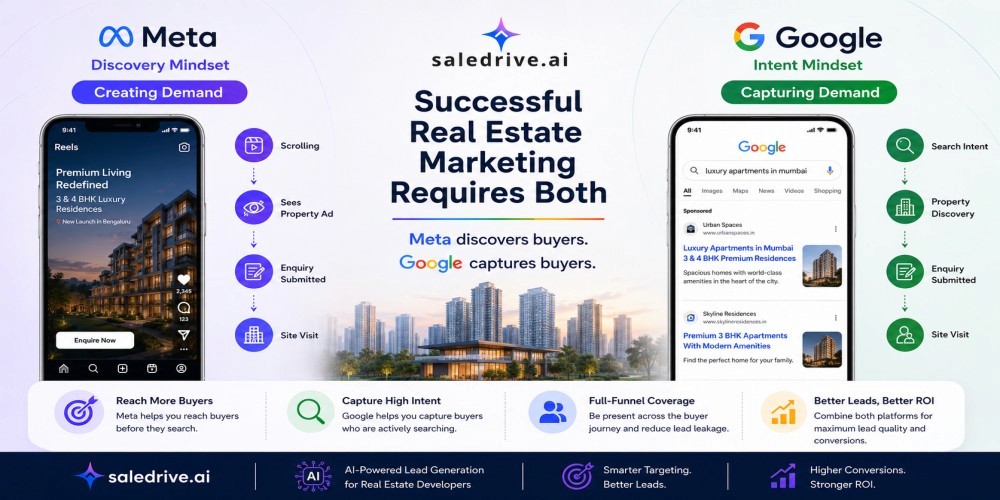
Users typically open Instagram or Facebook with the intention of discovering content, entertainment and updates from their network. They are browsing rather than actively searching.
This creates an environment where users are more receptive to new information and advertisements. A well-designed real estate campaign can interrupt a user's scrolling behaviour and introduce them to a project they may never have actively searched for.
In many cases, prospective buyers are not consciously looking for a property at that moment. However, an attractive advertisement showcasing a desirable location, premium amenities or an investment opportunity can create interest that did not previously exist.
This ability to generate demand rather than simply capture existing demand is one of Meta's greatest strengths.
For real estate developers, this translates into:
Lower cost per lead compared to many Google campaigns
Access to a broader audience pool
Strong visual storytelling through images and video
Greater scalability for lead acquisition
The intent on Meta may be passive, but with effective lead nurturing, follow-up and sales processes, these leads can be successfully converted into site visits and bookings.
The Google Advantage: Capturing Existing Demand
When users open Google Search, they are actively looking for information. When they open Gmail, they are managing communications. When they visit YouTube, they are generally focused on consuming specific content.
As a result, users are often less receptive to interruption-based advertising than they are on Meta platforms.
However, Google offers something equally valuable: existing demand.
A user searching for terms such as "luxury apartments in Mumbai" or "3 BHK flats near Thane" has already entered the consideration stage. They have identified a need and are actively seeking solutions.
These prospects often exhibit stronger purchase intent than users reached through social media advertising.
Google Search campaigns are therefore highly effective for:
Capturing high-intent prospects
Driving qualified website traffic
Supporting site visit generation
Converting users who are already researching properties
While these leads are frequently more expensive, they often require less persuasion because the initial demand already exists.
Brand Awareness: Google's Strongest Role
Beyond lead generation, Google plays a critical role in building visibility and trust.
YouTube, Display and Discover campaigns help developers maintain a consistent presence across the internet. This repeated exposure increases brand recall and ensures that prospective buyers encounter the project multiple times during their research journey.
For large launches and premium developments, this visibility can significantly strengthen overall campaign performance.
In this regard, Google excels as a brand-building and awareness platform.
The Real Estate Marketing Mistake Many Developers Make
One of the most common mistakes in real estate marketing is choosing between Meta and Google instead of using both strategically.
Relying solely on Meta means missing buyers who are actively searching for properties.
Relying solely on Google means losing the opportunity to influence buyers before they enter the search phase.
Modern homebuyers rarely make decisions after a single interaction. They may discover a project on Instagram, watch a YouTube video, search for reviews on Google and visit the website multiple times before finally booking a site visit.
A successful digital marketing strategy must account for this behaviour.
The Most Effective Approach
The strongest real estate campaigns combine Meta's ability to create demand with Google's ability to capture demand.
Meta identifies and engages potential buyers before they begin actively researching. Google ensures those same buyers continue seeing the project when they move into the consideration stage.
Together, these platforms create a full-funnel marketing ecosystem that reduces lead leakage to competitors and improves overall conversion efficiency.
At Saledrive AI, we help real estate developers optimise both Meta and Google campaigns through AI-driven targeting, audience intelligence and performance optimisation. By aligning platform strategy with buyer behaviour, developers can maximise reach, improve lead quality and generate stronger returns on advertising spend.
The question is not whether Meta is better than Google or vice versa. The real question is how effectively both platforms are working together to drive site visits and sales.